
School Clock Systems: A Practical Guide for K‑12 and Campus Facilities
School clock systems are synchronized timekeeping networks across educational facilities that keep every hallway, classroom, and gymnasium running on the correct time. Whether you manage a single building or an entire district, understanding how these systems operate is the first step toward eliminating scheduling chaos and reclaiming lost instructional minutes.
Key Takeaways
A synchronized clock system keeps all clocks showing the exact same time, improving punctuality for students and staff while reducing tardiness and confusion across campuses.
Wireless clock systems using RF and Wi-Fi eliminate complicated wiring, lower maintenance costs, and provide flexibility for renovations or new buildings.
A master clock can control multiple systems, including bells, HVAC, lighting, and emergency alerts, from one centralized hub.
Admoveo Systems provides wireless school clocks, master clocks, bell systems, and emergency messaging designed specifically for schools and universities.
Facilities managers can centralize clocks, bells, building automation triggers, and emergency alerts into one synchronized solution-contact Admoveo Systems for a quick quote.
What Is a School Clock System and Why It Matters
A school clock system is a coordinated network of analog and digital clocks, a master clock, and bell or relay controls that synchronize every room in a facility to the same second. Centralized control synchronizes every clock in the facility, eliminating discrepancies. These systems are used in K‑12 schools, universities, and even hospitals where consistent, accurate time matters for daily operations.
Synchronized timekeeping minimizes tardiness and maximizes instruction time between classes. Standardized timekeeping ensures seamless class transitions and bell schedules across campuses, and uniform, synchronized clocks create a cohesive, orderly institutional environment. Reliable time sync prevents conflicts during class changes, exams, and announcements.
For example, a mid-size district with five to ten buildings can use a synchronized clock system to standardize start times, passing periods, and lunch blocks. Synchronized time improves exam integrity and creates fairer testing environments by preventing discrepancies during high-stakes exams like the SAT or ACT. Key components include wall clocks, master clocks, bell controllers, relays, and optional message boards.
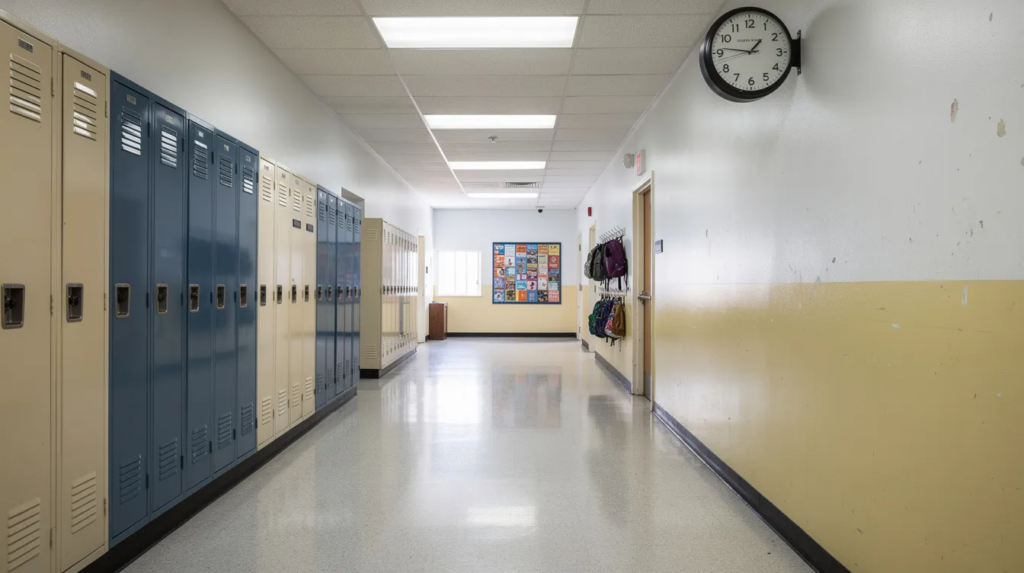
Core Components of a Synchronized School Clock System
Most modern school clock systems follow a hub-and-spoke model. The master clock sits at the center, maintaining precise time using internal oscillators or GPS receivers. It distributes the time signal to multiple secondary clocks via wired, wireless, or IP systems, and manages schedules through a web GUI or software interface.
Secondary clocks are analog or digital clocks that receive signals from the master clock. Battery-powered wireless clocks work in classrooms and corridors, while LED digital clocks offer better visibility in low-light conditions than analog clocks, such as in gyms and cafeterias. Many clocks now feature built-in countdown timers for tests and class transitions. Shatter-resistant polycarbonate lenses and durable ABS housings are designed for high-traffic school environments.
Modern clock systems can integrate with public-address and emergency notification equipment, and advanced systems can display visual message alerts during emergencies. IP/NTP Ethernet systems let clocks pull time data from internet servers or a local network, while modern Power over Ethernet clocks reduce battery changes and hardware failures. Advanced systems can send automated health alerts before clocks malfunction.
How Wireless Clock Systems Work in Schools
Legacy wired systems are traditional setups in which clocks are hardwired to a master control panel, requiring complex wiring and making renovations costly. Wireless clock systems changed that world entirely. Wireless systems use radio frequency broadcasts to synchronize clocks and can use RF, Wi-Fi, or Bluetooth technology.
In an RF-based wireless clock system, the master clock’s transmitter sends a time signal over a dedicated radio frequency. Clocks with built-in RF receivers auto-correct multiple times per day. RF systems operate in the same frequency range as Wi-Fi and two-way radios, but they can be configured to avoid interference, and repeaters can extend reach in large facilities. Wi-Fi clocks typically have an indoor range of about 150 feet from the nearest Wi-Fi router, while Bluetooth clocks have a limited range of 35 to 50 feet-making RF and Wi-Fi the preferred wireless technology for schools.
Wireless clocks require minimal maintenance compared to wired systems, and their battery packs last three to five years. Wireless clocks can be installed without hidden labor costs, a typical school district find installation was “seamless,” allowing staff to hang clocks in half a day. Synchronized systems automatically adjust for daylight saving changes and power outages. System clocks automatically adjust for daylight saving time, reducing manual labor. Admoveo’s synchronized clock systems can mix technologies, wireless clocks, PoE/IP clocks, and existing wired clocks, under one master clock, turning an obsolete system current through phased upgrades rather than a full rip-and-replace.
Scheduling Bells, Class Changes, and Building Automation
The real power of a synchronized clock system is centralized scheduling. Synchronized clock systems can trigger bells and announcements without manual intervention and automate scheduling for the entire year. Wireless master clocks can manage up to 99 schedules and schedule up to 99 events for regular days, early-release days, exam weeks, and summer school. Automation reduces the need for daily manual adjustments.
Master clocks can automate HVAC and bell systems through dry contact relays. Master clocks can control bells and alarms and interface with air-conditioning systems. RF clock systems can also control building aspects like lighting. Advanced master clocks coordinate with HVAC and lighting systems to save energy, for instance, triggering HVAC setbacks after the last bell or turning on parking-lot lights before morning arrival. Synchronized clock systems can interface with HVAC and security systems for better management and schedule multiple events daily. Automated bell schedules signal period starts and ends to reduce hallway congestion.
Facilities managers log in from a PC to adjust class periods, and changes propagate instantly to all wireless clocks and bell events. Wireless master clocks receive time signals from GPS satellites, making the posted schedules accurate to the second. Admoveo Systems can link the clock system with PA speaker systems, allowing pre-recorded announcements or tones to play exactly on schedule.
Emergency notification networks can broadcast alert tones during crises using clock systems, and synchronized time ensures emergency announcements execute simultaneously across buildings, supporting fire drill timing, lockdown drill consistency, and accurate timestamps for incident logs. Master clocks can automate control of multiple systems from one place, giving people a single point of focus for every time-based event in a building.
Choosing and Maintaining the Right School Clock System
When selecting a system, consider current infrastructure, future renovations, the number of clocks, budget, and total cost of ownership. Synchronized clock systems offer operational advantages over traditional wall clocks. Key factors include building size and construction type, whether your network can support Wi-Fi clocks, the need for integration with PA and intercom systems, and available IT resources.
The difference between maintaining older wired systems, with costly replacement parts and higher installation labor, and migrating to wireless clock systems is significant. Wireless clocks use solid-state movements, long-life batteries, and minimal wiring. Typical maintenance includes replacing batteries every three to five years, occasionally checking RF or Wi-Fi signals, and reviewing master clock schedules at the start of each term. Schools can phase upgrades by district or building, prioritizing sites with the highest maintenance costs.
Admoveo Systems pre-configures master clocks and wireless clocks before shipping, including time zone, NTP or GPS settings, baseline bell schedules, and even your school’s logo on digital displays, to reduce on-site setup time. With a two-year hardware warranty, lifetime training and technical support, and remote assistance for schedule programming, Admoveo helps you learn the system quickly and keep it running without draining your resources. Request a quick quote and an RF or Wi-Fi layout plan for your campus to get your upgrade started.
Frequently Asked Questions
How long does it take to install a wireless clock system in an existing school?
Small elementary schools with 30 to 60 clocks can often be installed in one to two days. Larger high schools or multi-building campuses may need several days depending on clock count and RF or Wi-Fi survey results. Most time goes to mounting clocks and verifying signal coverage because Admoveo Systems typically pre-configures the master clock and schedules before shipping.
Can we reuse our existing wired bells and speakers with a new master clock?
In most cases, yes. The master clock can control existing mechanical bells, strobes, and PA amplifiers via dry-contact relays or IP interfaces, preserving previous investments. Admoveo can design hybrid systems where new wireless clocks operate alongside wired bell circuits and legacy speakers that remain in service, providing flexibility without waste.
What happens to the clock system during a power outage or network failure?
Battery-powered wireless clocks continue to keep time locally and automatically resynchronize when power returns to the master clock or network, minimizing time drift. GPS or NTP time sources automatically realign the system after outages, so administrators rarely need to manually reset clocks.
Do wireless clock systems interfere with our existing Wi-Fi or two-way radios?
RF-based wireless clocks operate on dedicated, carefully selected frequencies within a specific frequency range and are engineered to coexist with school Wi-Fi and radio systems without interference. Wi-Fi clocks use standard network protocols and follow IT security policies, including encryption and VLANs, while using minimal bandwidth similar to low-traffic IoT devices.
How do we budget for a district-wide upgrade from wired to wireless clocks?
Break the project into phases by school or building, prioritizing sites with the most frequent clock failures or highest maintenance costs. Admoveo Systems can provide per-clock and per-building cost estimates, including master clocks, wireless clocks, and any required RF transmitters, to support capital planning over multiple fiscal years. This approach lets you create a manageable upgrade path without straining a single year’s budget.